Showing posts with label Language. Show all posts

Sunday, October 27, 2013

Language and Articulation Mixed units!

Inspiration has finally struck, and I managed 3 new units in a little over 24 hours!  These new activities look at targeting language and articulation in the same groups, but can also be used with language only students or articulation only student.

The Picture to talk about is slightly different than the coversheet and may contain more items to talk about

Each unit has:
1 page picture to talk about
1 page of language questions targeting: WH questions, basic concept comprehension, divergent naming, convergent naming, describing, comparing, listening comprehension and conversation questions.
1 page of articulation words
2 pages of game cards (can be used with the included activities or separately).

The language and articulation lists are in black and white to save color ink.  An added bonus is you have a choice to laminate to save paper, or print in black and white to save laminate! Not laminating could also allow you to take data on the sheets.

I also love that the therapy stimulus items are separate from the game cards because many of my children find having both together to be pretty distracting.

All are available on TPT!
Farm Language and Articulation
Outer Space Language and Articulation
Thanksgiving Language and Articulation

Friday, August 16, 2013

Candy Corn Synonyms & Back to School Sale

As I was browsing TPT and double checking my wishlist for the upcoming sale, I found this great clip art and remembered the activity I was planning on making.  This is an incredibly simple activity based on all of the pinterest inspired paint strip activities.  It's meant to be a quick and easy, low planning therapy activity, because we really all do need more of those!

Candy Corn Synonyms 
(link to TPT)


A word is written on the top of a piece of candy corn.  Students either independently or using the word bank write two synonyms for each word on the card.  If you laminate the cards and use dry erase markers you can do the activity over and over again.  A total of 18 synonym triplets are included.


As mentioned above, the big back to school sale is happening this week!  Check out my store on TPT and get your wishlists ready!  All of my items are 20% off and don't forget to enter the promo code for the extra 8%.  If your wishlist is looking anything like mine, that 8% really can add up!
 

Monday, August 12, 2013

Understanding Sentences with Jewel Collection Game

I'm always looking for more simple ways to work on simple auditory comprehension and responding to questions about verbally given information since it's such a critical skill for classroom participation and comprehension of classroom materials.


I did something a little different with this unit, I kept the therapy stimulus materials completely separate from the game materials.  I did this because I wanted both the game and the therapy materials to be as flexible as possible and also because I wanted to save peoples color ink by not doing color on every page.  

Check it out on TPT!

A total of 90 therapy cards are included (game cards are not counted).  Each card has three questions so you can pick and choose to target specific question types or you can ask each student in a group one question about the same sentence.  I really like asking multiple students questions about the same sentence because it engages students in the entire session and they think about each question for an opportunity to help a friend.  I also vary the order I ask questions in to continuously engage students.

All question types are not pictured here.
Questions include:
Who, What, When, Where, Why, How Many, choice questions and sequential questions.  

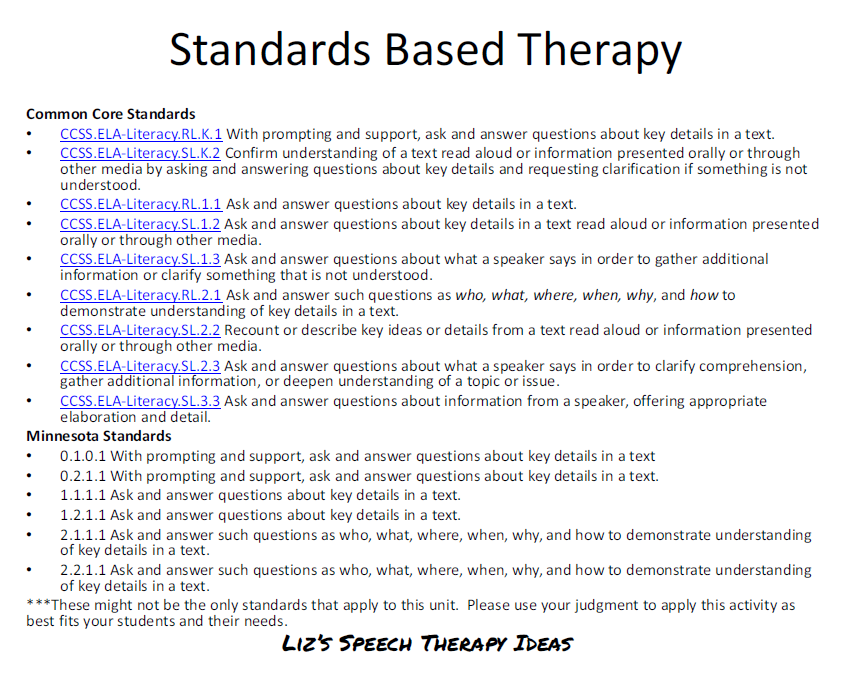
Once again, I've included a list of sample Common Core and Minnesota State standards that this unit addresses.

The jewel game is pretty simple to play and requires no reading.  All jewel cards are face down on the table.  Students attempt to collect as many jewels as possible.   If they get an X card they don't put it in their treasure chest.  The student with the most jewels at the end of the game wins!

Each shape of jewel is in all 5 colors.

I'm really excited for this game in particular, collected jewels are in the treasure chests.  The jewels are out of sight and you can limit the counting of jewels every turn, yet the treasure chest gives your fidgeting kiddos something to hang onto. 
Directions for folding and laminating to have open treasure chests are included in the unit.
If this is something you can use, head over to TPT and grab it!

Friday, August 9, 2013

Halloween Articulation Inferences Activity


I know it seems early for Halloween, but if any of you are like me it might take some time to get everything printed and ready to go for the holiday, and I'm planning on a back to school sale at some point so you can pick them up for a deal!  As one of my previewers for the unit said - Halloween seems to come really fast after the school year starts!

I, as many of us do, have students working on both articulation and language goals or groups that are mixed with the two goals.  Articulation is self explanatory, but language you can do inference and word retrieval skills.  I am always looking for activities to meet both areas because it means we spend more time in the session working and less time shuffling materials.  My students in mixed groups also enjoy all being able to do the same thing and I also like it because there is always one student who wants to do anyone's work but their own.  This activity is designed to use for either or both need areas.

I have made three separate Halloween Articulation Inferences activities. (Linked to my TPT store)
Set 1 has K, G, L and vocalic L
Set 2 has TH, SH, CH and J sounds
Set 3 has S, Z, R and vocalic L
The Complete Set has all sounds listed above, but is a bundle price for 20% off the price of all three.

Each sound has 32 question cards, most cards have inference questions but there are a few holiday trivia questions.  That means each set has 128 therapy cards plus game cards!  The complete set has 384 therapy cards.

The level of difficulty of the inferences varies within each unit so word banks are included so you can vary the level of difficulty as needed for your students.  Blank word banks are also included so you can mix and match cards for your language students.  Each card is labeled by phoneme so you can quickly resort the cards.  The vowel sounds are labeled as VR and VL.

Two types of cards have therapy questions on them - House cards and green and orange tree cards.  16 of each type of card are in each articulation set.


This unit marks the start of something new I'm doing - including a list of standards addressed with the unit.  The list of standards is an example of what standards might be addressed, but please keep in mind that others may be addressed.  You should use your expertise and clinical judgment about the needs and goals of your students.  My intention is to provide a jumping off point and a quick reference for all the busy therapists out there!  I included Common Core Standards because that is what most people use and the Minnesota State Standards (since I am in MN and I look them up anyway). 

Of course there is a simple game included to enhance student interest.  The play is fairly simple: each student is trying to get the most different cards to make up their town, they can count each kind of house and tree only one time.  The student with the biggest town at the end wins!  Street strips are included for your students to put their houses on.  Special cards are lose a house and take an extra turn.  The extra turn cards can be added to the town.
 Halloween is my favorite holiday and one of the few holidays that seems universal for my multicultural, multilingual student population (who doesn't like free candy, anyway!).  Out of my 55 kids last year, only one didn't celebrate Halloween.  I'm super excited to start using this and to break out my Halloween stickers!

Sunday, July 14, 2013

Targeted Tier II Vocabulary Words - TPT Unit

Well, for some reason, all of the ideas I've had since the end of the school year have decided to come pouring out of me this weekend, so I put in some good movies and decided not to fight it.  I'm most thrilled about finally figuring out a way to do a vocabulary unit!  I've been back and forth on what I wanted to do since March and finally figured it out.  It's on TPT, like right now!

I'm super excited to have a good resource to use with my students, especially since vocabulary is such a huge area.  Also, it's a critical skill for our kids to have.  I think we all know that despite our best efforts, many of our students may never be able use correct grammatical skills or speak/write in full sentences.  By focusing on vocabulary we can give them comprehension skills to help them understand the world around them. 


Word selection!  The source of endless frustration for every SLP attempting to address vocaublary.  Standards vary from state to state (MN has it's own version of the common core) and curriculum from district to district.  I picked the words I did because they fell on more than one list for vocabulary for the targeted grade level.  As we all know, different schools, programs and teachers choose to target different words at different times.  Use your judgment based on the needs of your students and school. Even though there was some consistently, the words may fall different grades on different list.

18 words are selected for each target grade level.  The different grade levels use different kinds of animals for easy differentiation, but can easily be mixed for student needs as needed. The animal picture used with each word is consistent for every animal to help with switching between grade levels.  This also allows for word/definition Match or Go Fish games.

The animals are as follows:
Grade 2 - Sea Creatures
Grade 3 - Farm Animals
Grade 4 - Forrest Animals*
Grade 5 - Wild Animals*
*Categorized the same way the clip art creator Pink Cat Studio did.

 Each animal is only used with two different vocabulary words to (hopefully) help with sorting and resorting, since I'm sure we all know how easily things get mixed up as we rush from one group to the next.

Four Types of Cards are in this unit:


Side note - but seriously, how cute is that alligator!


Four Types of Cards:
Word Cards (color and black and white)
- Vocabulary cards are in color and black and white (not pictured) so students can personalize and color a set to keep.
Definition Cards
Yes/No + Why Question Cards
 - Yes/No question prompts followed by a why question to help you see how your student is thinking.
Antonym/Synonym Question Cards
- Check for understanding of new vocabulary in context.


A word list is included for each grade level so you can find a specific word at a glance.


Writing pages are included for Word and Sentence levels since writing words can be critical to retention of new words.

If you are as excited about this one as I am, head over to TPT to get it now!

Make sure you like my Facebook page so you can say updated on flash freebies as well as new materials.

Saturday, July 13, 2013

Flying for Cause and Effect

Cause and effect is one of those skills that many of my students have a lot of trouble understanding.  Cause and effect is so important for cognitive organization and to help students understand concepts that are happening in their classrooms.  I want to continue working on this, and have a variety of stimulus activities to work on with different students. Thus I needed more materials! We always need more materials.  How does that commercial go again? "We want more, we want more!"


Anyway I broke the cause and effect into two sections.  The first takes out the actual vocabulary "cause and effect" and uses the phrases "what would happen if?" and "what will happen next?"  The idea behind this is to get students to start thinking about how different events are related.  Next there are cards that ask students to identify possible causes and effects.  Both multiple choice and open answer cards are provided.  A cause/effect cue sheet is included!  Check it out on TPT!

Both types of predicting outcomes cards.

"Gotcha" or game cards are provided for the open ended response cards for both levels of difficulty.
Two kinds of cause and effect cards.  Both cause/effect prompts are included in each format.


I also made a flying in the clouds game to go with this activity.  Students roll a dice and go to the next biggest number.  If they land on an airplane space, they follow the dotted line to either go ahead or backward.


If you're interested make sure to check this one out on TPT! 

Also make sure to like my Facebook page.  As of this moment, we're 21 likes until a flash freebie!  Like me and comment below to vote for what it should be!

Tuesday, July 9, 2013

Collecting Slimy Snails: A Describing Activty (and a summer update)

WOW!  It has been a long time since I have posted anything.  I had most of June off, with some training days for a math class and SIOP (EL certification).  I can't say enough good things about SIOP, especially since it has classroom teachers working on specific language goals with the students in the classroom.   It just happened that I ended up taking time off from blogging and creating as well off work.  I do have a monster pile of laminated materials getting reading to go back to school, and I think that the new laminator can be officially termed "broken in."  I also did a massive rush for finishing some baby gifts for some of my friends (pictured on my facebook).  Now that I'm back in the ESY mode, it's time to go back to blogging and materials!

Of course, the "to cut" pile is not included.

I have a new activity for everyone, because what better way to come back from break than to have a freebie?

I've actually had this one mostly done for some time now, and am finally getting around to finishing touches and, of course, sharing it.


Students need to sort attributes and describing words into pails as they collect snails.  I also included blank Snails and Pails for you and your students to personalize the activity and describe things that your students want to talk about!


This is a freebie on TPT so head over and grab it!

Saturday, June 8, 2013

Asking and Answering Questions Cupcakes

I'm a big fan of using visuals with my students, it lets them start to feel independent and start to figure out things on their own.  There are so many great answering questions units with charts out there,  but not as many for asking questions.  This unit has identical but opposite charts for asking and answering questions to help students make connections between the two.


Asking questions
-          Question word chart formatted from answers to questions
-          How many questions card
-          Keep track of how many questions a student can ask about a topic using dry erase markers or tokens
-          4 and 6 Star Options so you can adjust the level of difficulty
-          Simple sentences for students to ask questions about
-          Some of the sentences might not be true for you, A blank sheet is included so you can add and remove as you need to!


Answering Questions
-          Question word chart formatted from questions to answers
-          Questions for students to answer
-          105 question cards!

Both asking questions and answering questions cards are shown.

Check it out on TPT!

Saturday, May 18, 2013

National Geographic Easy Readers

I'm always looking for ways to connect my classroom to things that are going on in the general education classroom.   As every speech therapist knows, this can be extremely challenging - multiple grade levels, multiple needs/IEP goals, and different teachers doing different things at the same time within the same grade.   My school is also an IB world school, so there are themed units that build on each other from grade to grade as the kids progress through elementary school.

My latest find for connecting to the curriculum is National Geographic Easy Reader books.  I've been using the animal books to get the big ideas of habitat, predator and prey across to my second graders for the past few weeks.  There are also other non-fiction titles that would connect well to other units.  I've been using the books with my second graders, and lower third graders.  I don't have any first graders right now, but would also use the books with that grade level.


I love these books.  My kids are very interested in the different animal pictures (and they are great ones) and learning about non-fiction in general.  I also can get some great non-fiction comprehension questions as well as practice working on inference skills throughout the books.  One of my biggest inference areas is when the author talks about what certain animals like, we make inferences about what they don't like.  The books also have great vocabulary for targeted areas.  My second graders are learning about animals right now and some of their key words are habitat, predator and prey.  The key vocabulary words are highlighted in the text with a pop out word + definition, and then reviewed at the end of the book.  I really like this, since as we all know, our students need so many more times hearing and seeing a word to learn it. 


I've found that both levels 1 and 2 are great for single speech session lessons, while level 3 books usually take 2 days with some review time on the second day.  I also don't read the books word for word, after a few trips through, I'm paraphrasing.  I skip over some parts and spend lots of extra time on other parts.

Sunday, May 5, 2013

Summer Sun Negation Unit

It is now the 5th, and May 3 in Minnesota and it involved Snow, Rain and Sleet and Rain again in that order.  So clearly I had to take the time to finish and blog about my negation unit with summer fun pictures!   I was going to post this on Friday, but internet shenanigans and being sick means it has taken until Sunday to get it done.

This one comes from having discovered that several of my kids don't understand using negation, and needing more materials!  This huge unit has a total of 358 therapy cards, plus additional blank cards so you can add your own sentences.  Check it out in my TPT store.


This unit has both negative words and negative contractions.  Both units have two kinds of cue cards to use when working on the the unit.  An explanation of negatives and a negative word cue sheet.


The Negative words part of the unit has 2 Levels, and there are 40 therapy cards at each level.
Level One: Multiple Choice fill in the blank sentences
Level Two: Fill in the blank sentences (pictured)

Game cards are provided too!


You can start working on negative contractions by playing a match game!


The negative contractions included throughout this unit are:


Can’t, Won’t, Don’t, Doesn’t, Haven’t, Hasn’t, Isn’t, Couldn’t, Wouldn’t, Aren’t, Didn’t, Wasn’t, Weren’t,  Shouldn’t, Hadn’t


The Negative Contractions in sentences part of the unit also has 2 Levels, and there are 80 therapy cards at each level.
Level One: Multiple Choice fill in the blank sentences (pictured)
Level Two: Fill in the blank sentences

There is also an expressive language section for the negation unit!  Students are asked to tell about something they don't/can't/won't (ect) do.  Contractions included in this part of the unit are:


Don’t (8), Can’t (8), *Aren’t [am not] (8), Didn’t (8) Won’t (8), Hasn’t (4) Doesn’t (4), Haven’t (8), Isn’t (8), Shouldn’t (8), Couldn’t (8) and Wouldn’t (8)
*some of the responses to the Aren’t questions go to “I am not” and it is noted on the cards with a hint


Game cards are also included for the sentence creation cards.


At the end of everything, I made a 2 page board game you can print and use with your students while they are working on all levels of negatives!

So if this looks like something you can use - head over to TPT and check it out!